
 Account

V-Ray 7.4, Hotfix 1 for Blender: What's New in V-Ray 7.40.01
POSTED 21st OF Sep, 2026, Posted by Summer Magdaraog

POSTED 21st OF Sep, 2026, Posted by Summer Magdaraog

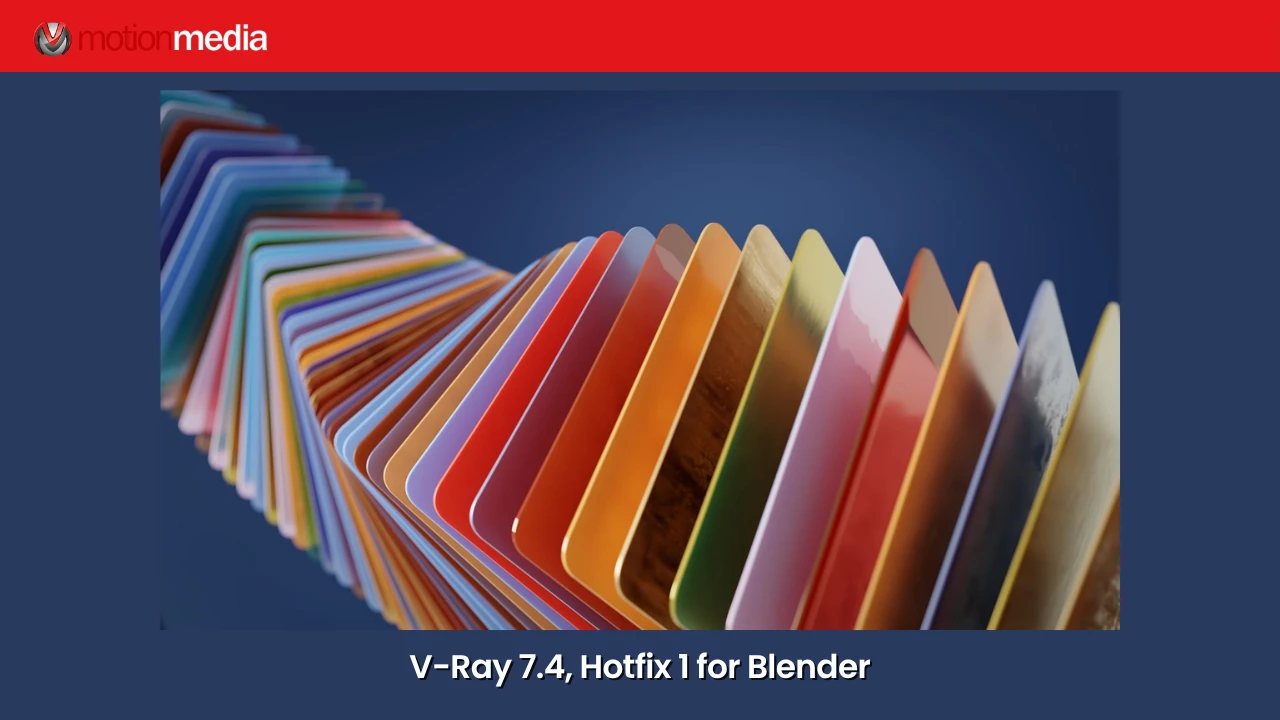
Chaos has released V-Ray 7 for Blender Update 4.1 (7.40.01), adding new tools for scattering, real-time visualization, scene interoperability, materials, Gaussian Splats, and scene management. The update also expands Cycles and Geometry Nodes support and includes fixes across rendering, animation, materials, viewport interaction, and stability. Chaos states that the new features and changes apply to both the V-Ray for Blender Community Edition and Commercial Edition.
The main additions in Update 4.1 include:
V-Ray for Blender can now render and relight Gaussian Splats.
Gaussian Splatting represents a captured 3D scene using 3D Gaussian points rather than conventional mesh geometry. In V-Ray for Blender, Gaussian Splats can be used as environments or as individual objects. Chaos currently documents .ply as the supported Gaussian Splat file format, with support for loading sequences as well.
For environment workflows, Gaussian Splats can provide parallax and view-dependent effects and can occlude other objects in the scene. For individual objects, V-Ray provides controls for camera visibility, shadows, reflections, refractions, color, intensity, and matte-surface behavior.
The new lighting controls extend Gaussian Splat workflows beyond simply displaying captured data, allowing the splats to participate in a V-Ray lighting setup.
Chaos Scatter is now available for V-Ray for Blender as an additional add-on. It uses Blender Geometry Nodes to distribute objects across surfaces, edges, and splines.
Users can control distribution, density, slope, altitude, transformations, camera clipping, and the models being scattered. The update also adds the Chaos Scatter Surface Color texture and support for custom per-instance user data in Geometry Nodes.
Update 4.1 also adds Out of Frustum subdivision control, giving users more control over subdivision for geometry outside the camera view.
V-Ray for Blender now supports Live Link to Chaos Vantage for real-time scene previews and rendering.
Changes made in Blender are reflected in Vantage, so users can evaluate lighting, materials, cameras, and other scene changes without repeatedly exporting the scene for a separate preview. Changes made in Vantage are not written back to Blender, making the workflow non-destructive.
Chaos Vantage 3.0.0 or newer is required. Vantage runs on Windows. When the Live Link is initiated from Blender on macOS or Linux, Chaos requires an active Distributed Rendering connection to a Windows machine running Vantage.
Update 4.1 adds a new way to bring V-Ray Scene (.vrscene) files into Blender as native objects.
This improves interoperability with other V-Ray integrations, including workflows involving 3ds Max, Maya, and Cinema 4D. When supported elements have Blender or V-Ray equivalents, they can be imported separately and edited in Blender instead of rebuilding the scene from scratch.
Not every element can be converted to a native object. Unsupported elements may be imported as blackbox objects. These objects can still render but cannot be edited individually. Chaos also notes that large scenes can take longer to import because the individual elements need to be processed separately.
For scenes that do not require individual editing, V-Ray Scene Reference can instead import the .vrscene as a more compact scene object.
Update 4.1 adds two new scene-management tools:
V-Ray Material Manager provides a dedicated interface for working with V-Ray materials, while V-Ray Object Lister provides another way to locate and manage scene objects.
The update also adds material thumbnails, improves material preview performance, and allows utility textures and bitmaps to be added directly from the Material tab instead of requiring the Node Editor for those tasks.
A new V-Ray Infinite Plane geometry object is now available in V-Ray for Blender.
The update also improves geometry workflows through additional Geometry Nodes support and more efficient geometry attribute export. V-Ray now exports only the geometry attributes that are used during shading.
Update 4.1 expands V-Ray's ability to render and convert additional Cycles content.
Newly supported Cycles nodes and features include:
The update also improves Cycles Principled material conversion, procedural texture handling, Generated coordinate conversion, and other material-conversion workflows.
Other Blender workflow changes include support for custom per-instance user data in Geometry Nodes, improved UV-only behavior when using the UVW Randomizer, support for Cycles Thin Wall, and improved node arrangement when importing assets or using Node Wrangler's Arrange Tree function.
Update 4.1 adds several rendering controls and fixes:
The update also preserves displacement texture links when changing displacement types, improves V-Ray material bump connections, and adds support for importing V-Ray Luminaires from Chaos Cosmos.
Chaos Cosmos workflows receive several changes in Update 4.1.
The release adds support for Chaos Cosmos asset sets, improves the naming of imported Cosmos assets, and improves the arrangement of nodes when importing assets.
V-Ray also adds support for importing V-Ray Luminaires from Cosmos lights.
Hair export has been optimized for particle systems and curves. The update also addresses several issues involving particle hair, curve-converted geometry, Geometry Nodes scenes, instanced decals, and motion-blur overrides.
Interactive rendering receives multiple fixes involving render regions, scene visibility, material previews, Motion Blur, LightMix, render results, and camera switching.
V-Ray GPU users also receive a status indicator during kernel compilation, giving clearer feedback while GPU rendering resources are being prepared.
Beyond the new features, Update 4.1 addresses a broad set of issues across V-Ray for Blender.
The fixes include problems with:
The installer also adds a direct link to the V-Ray documentation from its Directories page.
V-Ray 7 for Blender Update 4 introduced Blender 5.2 support and other rendering and workflow improvements.
Update 4.1 (7.40.01) builds on that release with Gaussian Splats rendering and relighting, Chaos Scatter, Chaos Vantage Live Link, native .vrscene import, V-Ray Material Manager, V-Ray Object Lister, V-Ray Infinite Plane, and additional Cycles, Geometry Nodes, rendering, and stability improvements.
For users working with Blender 5.2 or newer V-Ray 7 features, Chaos recommends checking the current compatibility documentation before updating an existing production environment. Chaos's compatibility table currently lists V-Ray 7 Update 4 with supported Blender releases including Blender 5.2 LTS, 5.1, 5.0, 4.5 LTS, 4.4, 4.3, and 4.2 LTS.
Update 4.1 is particularly relevant for Blender users who need Gaussian Splat workflows, procedural scattering, real-time Vantage previews, or better interoperability with other V-Ray applications.
It also adds practical improvements for users working with Cycles materials, Geometry Nodes, Chaos Cosmos assets, V-Ray GPU, hair, render elements, and V-Ray's material and object-management tools.
Before updating a production project, check the V-Ray for Blender compatibility and system requirements for your Blender version and hardware. Chaos currently lists Windows, macOS, and Linux system requirements separately, including platform-specific CPU, RAM, GPU, and operating-system requirements.
Motion Media is an authorized reseller of Chaos software, including V-Ray solutions for Blender.
Share: