
 Account

What’s New in iZotope RX 12
POSTED 29th OF Apr, 2026, Posted by Summer Magdaraog

POSTED 29th OF Apr, 2026, Posted by Summer Magdaraog
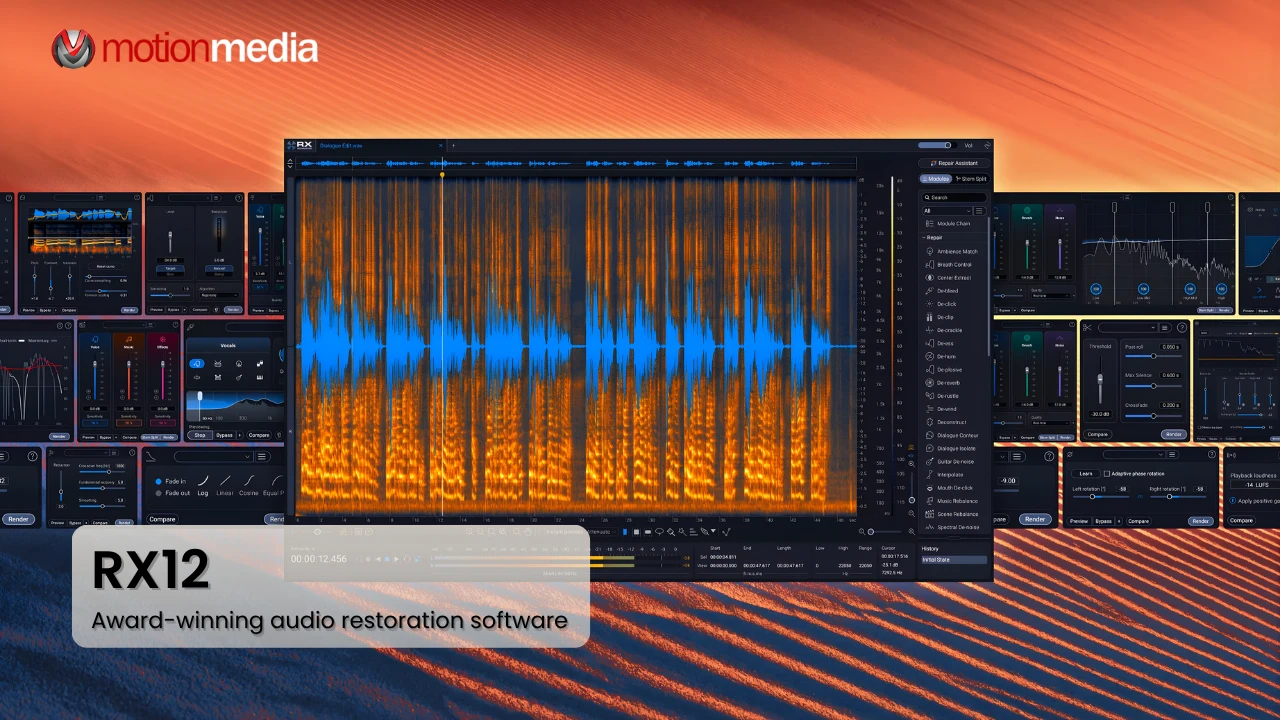
Audio issues remain a constant in production workflows. Noise, distortion, room tone inconsistencies, and unclear dialogue are still common across film, broadcast, music, and content creation.
iZotope RX 12 continues to develop its core function: professional audio repair and restoration through spectral editing, dialogue processing, and AI-assisted cleanup tools.
This release focuses less on adding entirely new categories of tools and more on refining how existing workflows perform in real production environments.
RX 12 builds on the established RX workflow by improving speed and responsiveness across core restoration tasks.
The main direction of the update is workflow efficiency, particularly in:
The emphasis remains on practical use in post-production rather than experimental features.
Dialogue processing continues to be one of the primary use cases for RX.
RX 12 maintains and improves tools designed to address common speech-related issues, including:
These tools are intended for corrective work, where the goal is to restore intelligibility rather than alter the sound creatively.
Spectral editing remains one of RX’s defining features and continues to serve as the foundation of most repair workflows.
It provides a visual representation of audio frequencies, allowing precise targeting of unwanted elements.
Typical applications include:
This approach is widely used in post-production because it allows targeted fixes without affecting surrounding audio.
RX 12 continues to expand the use of machine-assisted analysis in audio repair workflows.
Instead of relying entirely on manual correction, RX can now assist in identifying and processing common audio issues more efficiently.
These systems are used to support tasks such as:
The intent is to reduce time spent on repetitive corrections while preserving manual control.
RX 12 continues to function in two primary modes:
This dual approach allows RX to be used both as a dedicated restoration tool and as part of larger production pipelines.
RX remains widely used across professional audio workflows, including:
Its primary role is consistent across these areas: improving the quality of recorded audio that cannot be fixed at the source.
Motion Media is an authorized reseller of iZotope software, including RX 12.
Share: