
 Account

3DCoatTextura 2026.11 Adds GPU Node-Based Texturing, Procedural Materials, and GLB Export
POSTED 27th OF Jul, 2026, Posted by Summer Magdaraog

POSTED 27th OF Jul, 2026, Posted by Summer Magdaraog

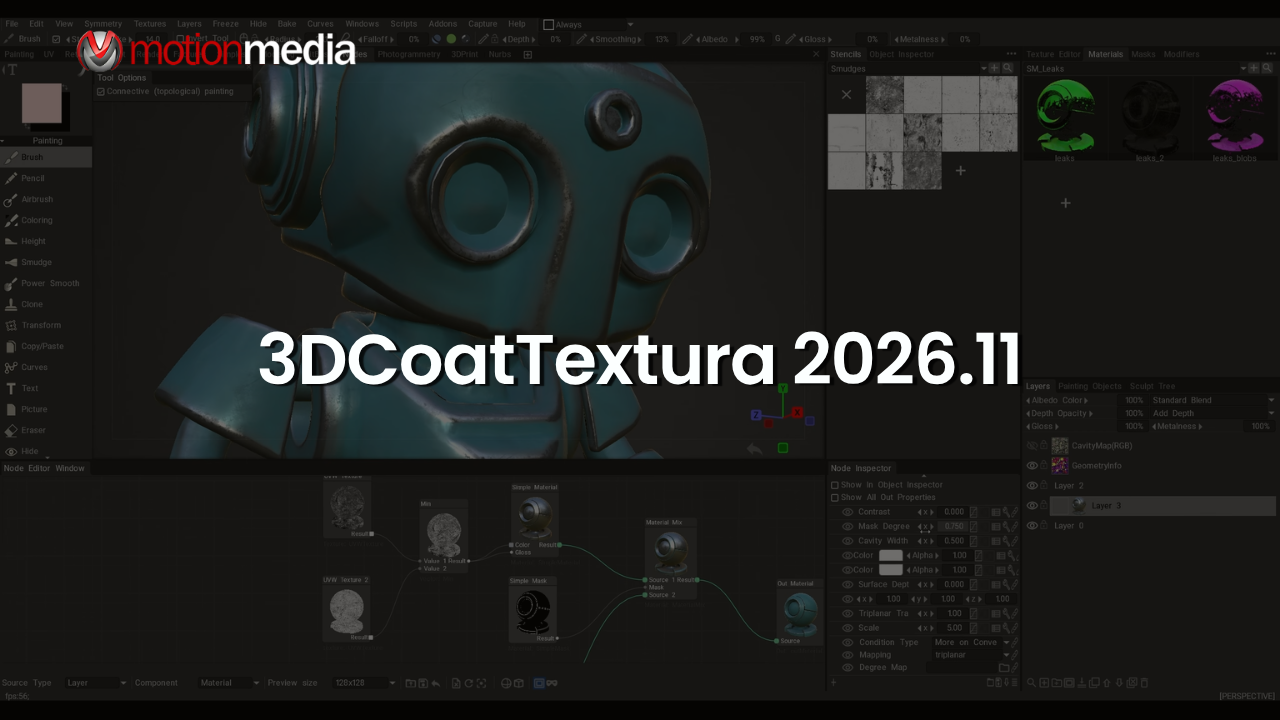
3DCoatTextura 2026.11 introduces a new GPU-powered node system for creating and editing procedural textures. The release also expands the material system to 30 physically based channels, adds node-based materials, masks, modifiers, and filters, includes a library of procedural assets, and improves interoperability with LWO3 import and GLB export.
The features in this release are available in both 3DCoat and 3DCoatTextura.
Version 2026.11 introduces the 3DCoat Node System, allowing artists to build materials and texture effects using a visual node editor.
The workflow is non-destructive, so material properties remain editable throughout production. Parameters such as base color, roughness, glossiness, rust intensity, and surface scratches can be adjusted without repainting the texture. Changes are displayed directly on the model in real time.
This gives artists the flexibility to refine materials throughout a project instead of committing to permanent edits early in the process.
Procedural nodes are dynamically compiled into GPU shaders using NodeGraph Language (NGL).
Noise generators, mathematical operations, and procedural effects are evaluated on the graphics card, allowing complex node networks to be processed without relying entirely on the CPU.
The node system supports several procedural asset types that can be reused across projects.
Smart Materials can respond to model data such as curvature and ambient occlusion, allowing materials to adapt automatically to different surfaces.
Masks can be generated procedurally for effects including:
Because masks remain procedural, they can be modified at any stage without rebuilding the effect.
Procedural Modifiers, also referred to as Deformers, apply geometry changes through the node system, making shape adjustments editable throughout the workflow.
Procedural Filters modify existing texture or layer data instead of creating new materials. They provide a reusable way to apply post-processing effects while preserving the original texture information.
The update includes a library of node-based assets that can be used immediately.
The library contains:
Materials and masks can be combined directly from the library without building a node graph from scratch.
A new inGizmoTransform node provides interactive controls for procedural texture placement.
When connected to UVWTexture, TriPlanar, or FragCoord nodes, artists can adjust texture position, rotation, and scale directly in the viewport.
3DCoatTextura 2026.11 adds support for importing LWO3 files created in LightWave 3D.
The update also introduces GLB export, making it easier to transfer assets to applications that support the glTF format, including Blender and real-time workflows.
3DCoatTextura 2026.11 focuses on expanding procedural workflows rather than changing the core painting experience.
The introduction of GPU-powered node-based texturing enables non-destructive editing for materials, masks, modifiers, and filters. The release also broadens the physically based material system with 30 supported channels, adds a built-in procedural asset library, and improves compatibility with modern 3D pipelines through LWO3 import and GLB export.
Whether you're creating game assets, product visualizations, or digital sculptures, 3DCoatTextura 2026.11 provides new procedural tools while preserving the texture painting workflow artists are already familiar with.
Explore the latest version of 3DCoatTextura from Motion Media to access the newest features and workflow improvements.
Share: