
 Account

PFTrack 26.05.19 Introduces Hero Cloud and New Gaussian Splat Workflows
POSTED 21st OF May, 2026, Posted by Summer Magdaraog

POSTED 21st OF May, 2026, Posted by Summer Magdaraog

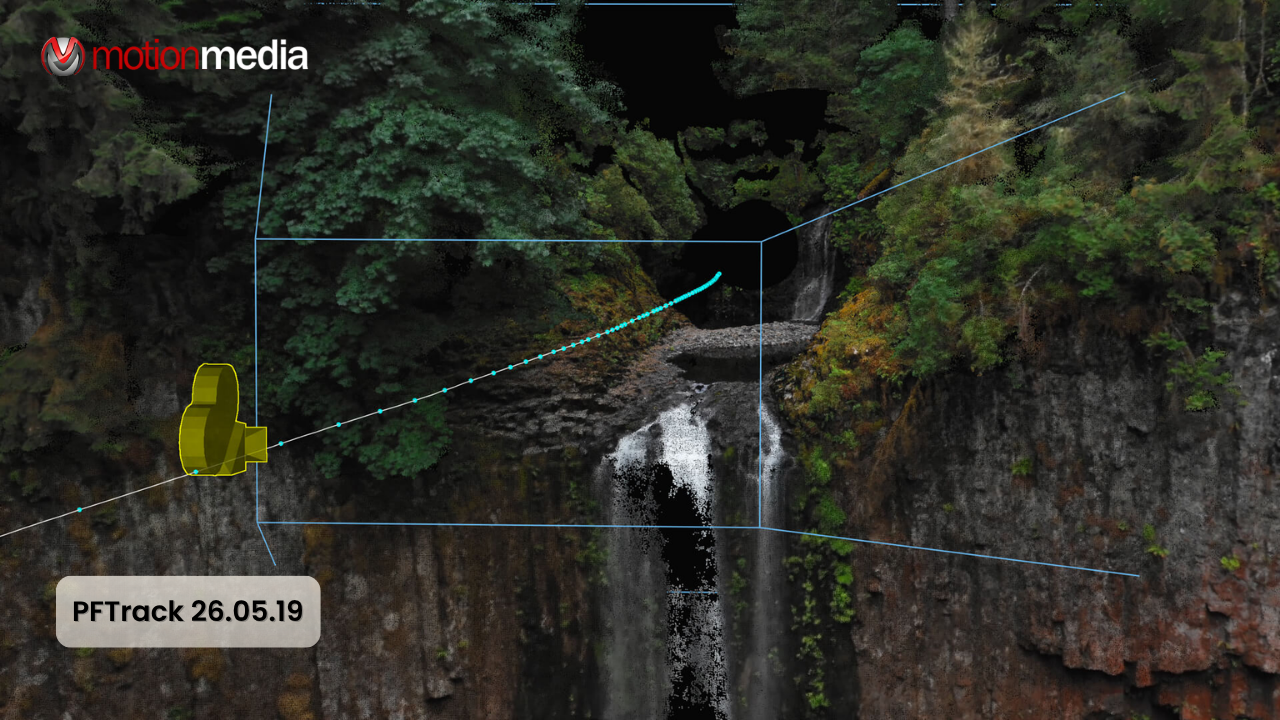
The Pixel Farm has released PFTrack 26.05.19, introducing several major workflow updates focused on dense point cloud reconstruction, Gaussian splat pipelines, USD interoperability, and single-shot environment reconstruction.
The update introduces Hero Cloud, a new node that generates measured dense point clouds directly from tracked footage. It also adds direct COLMAP export for Postshot workflows, expanded USD export capabilities, Photo Mesh integration, and a revised Solo trial with full export access for seven days.
As an authorized reseller, Motion Media is highlighting the most important additions included in the release.
The largest addition in PFTrack 26.05.19 is the new Hero Cloud node.
Available under the Geometry category, Hero Cloud generates a measured dense 3D point cloud from a solved camera track using a single plate or shot. The system reconstructs scene depth based on camera movement and parallax captured in the footage.
The feature supports footage captured from:
Any sequence with sufficient camera movement and parallax can be used to generate a dense reconstruction.
Hero Cloud is available in all PFTrack editions, including Solo, Studio, and Enterprise.
PFTrack 26.05.19 also adds direct export support for Postshot workflows.
Users can now export Hero Cloud point clouds and tracked camera data in COLMAP format through the Scene Export node. COLMAP is widely used for Gaussian splat training and neural reconstruction workflows.
The updated workflow allows artists to:
This reduces the need for intermediate reconstruction utilities during neural rendering and environment capture workflows.
The USD export pipeline has also been expanded.
PFTrack now supports exporting dense point clouds with:
This improves compatibility with USD-based workflows and downstream applications such as:
Instead of exporting only positional coordinates, the updated workflow preserves additional directional and visual data for downstream scene reconstruction and rendering tasks.
The update also introduces a new Active Camera viewport mode.
Viewer windows can now snap directly to the active clip’s tracked camera pose, making it easier to compare reconstructed geometry against the original source footage.
The feature is particularly useful for validating Hero Cloud reconstructions and reviewing solved camera movement inside the scene.
For Studio and Enterprise users, Photo Mesh now supports Hero Cloud point clouds as direct input.
This creates a full single-shot reconstruction workflow inside PFTrack:
The integration reduces the need for external meshing tools during environment reconstruction workflows.
The PFTrack Solo trial has also been updated.
New trial users now receive full export functionality for seven days instead of evaluation-only access.
During the trial period, users can fully test workflows involving:
This allows artists and studios to evaluate complete production workflows before purchasing.
PFTrack 26.05.19 also includes several workflow and stability updates across the application.
PFTrack 26.05.19 expands the software beyond traditional camera tracking workflows by adding integrated dense reconstruction and Gaussian splat export capabilities.
With Hero Cloud, Postshot export support, expanded USD workflows, and Photo Mesh integration, the release introduces a more connected pipeline for:
The update also reduces dependency on separate reconstruction utilities by allowing more of the workflow to remain inside PFTrack.
Motion Media is an authorized reseller of PFTrack by The Pixel Farm.
Our team can help you:
Explore PFTrack licensing and workflow solutions through Motion Media.
Share: