
 Account

Maxon and Tencent Cloud Partner to Integrate HY 3D AI Engine into Cinema 4D
POSTED 12th OF Mar, 2026, Posted by Summer Magdaraog

POSTED 12th OF Mar, 2026, Posted by Summer Magdaraog

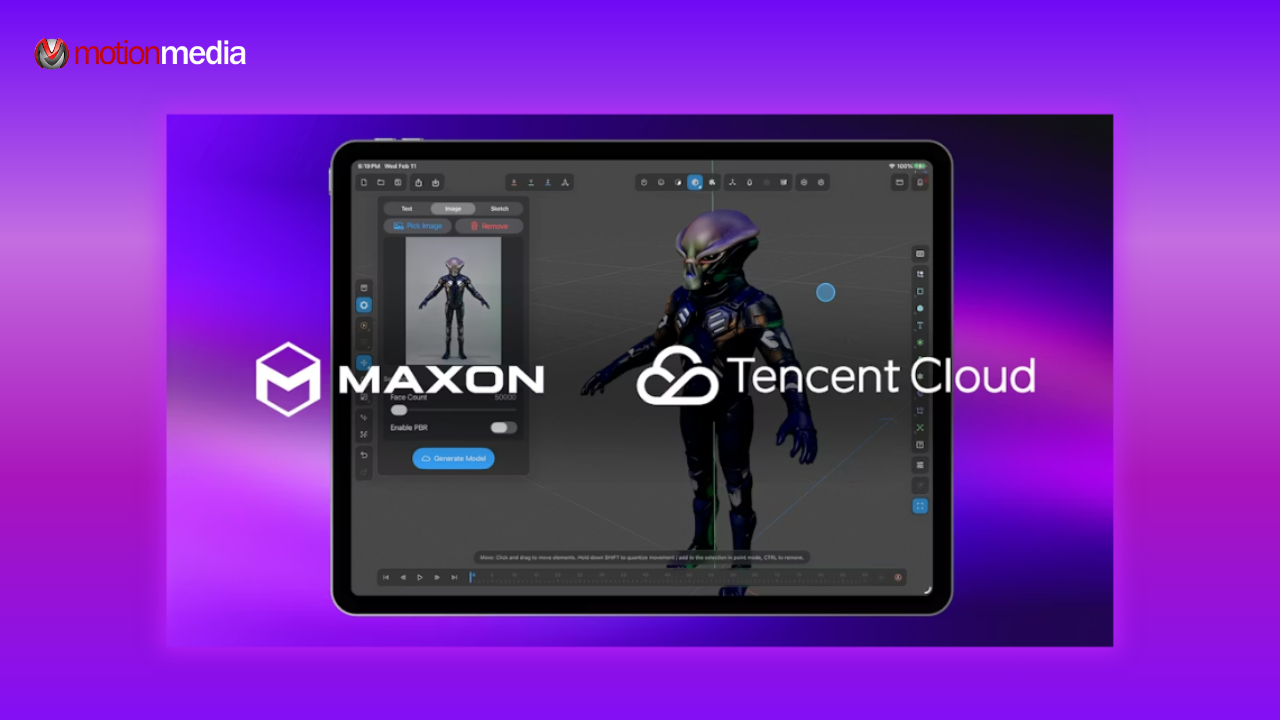
Artificial intelligence is rapidly becoming a major driver of innovation across creative industries. From generative images to automated video workflows, AI tools are transforming how digital content is produced. Now, AI-assisted technology is moving deeper into professional 3D production pipelines.
Maxon, the developer behind industry-leading creative tools, has announced a strategic partnership with Tencent Cloud to integrate the HY 3D Global AI Engine directly into Cinema 4D.
The collaboration introduces a new approach to 3D asset creation by allowing artists to generate base 3D models using AI and then refine those models inside Cinema 4D’s professional toolset.
The announcement was revealed during Mobile World Congress 2026, highlighting the growing role of artificial intelligence in the future of digital content creation.
For motion designers, visual effects artists, product designers, and creative studios, the integration signals an important step toward AI-assisted 3D workflows that accelerate ideation without replacing artistic control.
The demand for 3D content has expanded rapidly across industries including:
As production timelines become shorter and content demands increase, creative teams are constantly searching for ways to accelerate early-stage workflows without compromising quality.
Generative AI technologies are emerging as one of the most promising solutions. Instead of manually building every asset from scratch, AI can assist artists by generating initial geometry, allowing them to focus on refinement, storytelling, and design decisions.
By integrating AI directly into professional software, companies like Maxon aim to combine the speed of automation with the precision and creative flexibility required by professional artists.
The HY 3D Global AI Engine is a generative AI technology developed by Tencent Cloud that can create base 3D models and UV maps from text prompts or image references.
In practice, this means artists can describe a concept such as an object, prop, or design and generate a starting 3D model automatically. The AI system interprets the prompt and constructs a rough model that can then be edited and refined using traditional 3D tools.
Rather than replacing modeling workflows entirely, the technology is designed to accelerate the earliest stages of asset creation, where artists typically spend time blocking out forms and experimenting with ideas.
According to the official announcement from Maxon, the integration allows users to generate initial models that can then be developed further within Cinema 4D’s modeling environment.
Once the HY 3D AI engine is integrated, artists will be able to generate base assets directly within their Cinema 4D workflow.
The process typically follows several stages:
Artists can start by entering a text prompt or providing an image reference describing the object they want to create.
The AI engine analyzes the input and generates a basic 3D model.
The AI system produces the base geometry along with UV mapping, which helps prepare the asset for textures and materials.
This step significantly reduces the time needed to create early model structures.
Once the model is generated, artists can refine it using Cinema 4D’s standard modeling tools. This includes:
The AI output becomes the starting point for further creative work rather than the final asset.
The integration also aligns with the broader Maxon One ecosystem, where multiple tools work together within professional pipelines.
For example:
This ensures that AI-generated models can seamlessly fit into existing production pipelines used by motion designers, visual effects artists, and creative studios.
Rather than introducing a completely separate AI tool, the integration brings generative capabilities directly into a familiar professional workflow.
One of the key messages from Maxon’s announcement is that AI should assist artists rather than replace them.
Professional 3D production requires creative direction, technical precision, and artistic refinement elements that cannot be fully automated.
Instead, the HY 3D AI integration focuses on helping artists:
By accelerating these stages, artists can spend more time focusing on the final design and creative storytelling.
This approach reflects a broader industry trend where AI is used as a creative accelerator rather than a replacement for skilled professionals.
The integration of generative AI into Cinema 4D represents a significant milestone for the platform.
Cinema 4D has long been known for its accessibility, procedural workflows, and powerful motion graphics capabilities. With the addition of AI-assisted modeling tools, the software continues evolving to support modern production needs.
As generative technologies mature, they could become a standard part of creative pipelines, helping artists iterate faster while maintaining the precision required for professional work.
For studios and individual creators alike, AI-assisted workflows may open new possibilities for rapid prototyping, design experimentation, and faster content production.
According to the official announcement, the HY 3D AI engine integration is expected to arrive later in 2026, with additional details about availability and implementation expected in future updates.
As Maxon continues developing AI-assisted workflows, the company is positioning Cinema 4D as a platform that combines traditional 3D production tools with emerging technologies.
Cinema 4D remains one of the most widely used tools for motion graphics, visual effects, product visualization, and 3D design.
With innovations such as AI-assisted modeling on the horizon, the platform continues to expand its capabilities for modern creative production.
If you want to learn more about Cinema 4D, its features, and licensing options, you can explore the product page below.
Explore Cinema 4D
Share: